This robot is totally crazy smart. What do you think DARPA will use it for?
Thursday, March 27, 2008

Cool Science Stuff!
 SEA SHRINKS FOAM Cups and their messages back from the Arctic Ocean: left, from recent Russian dives; right, from an earlier dive, with a landlubber.
Far Below the Surface of the World’s Oceans, a Tough Place for Foam Cups
The New York TimesWednesday, March 5, 2008

Saturday, November 10, 2007

Saturday, October 13, 2007
Donor's Choose

If you haven't heard of this site already, you must visit it. Now!
This site allows teachers to write 'mini-grants' to fund small classroom projects and allows regular folks like you and me to quickly and easily donate to those projects, knowing our funds are going directly to help improve classroom instruction. How cool is that?

Right now, there is a $100,000 blogger challenge being run by Sarah Bunting of Tomato Nation. So far, over $75,000 has been donated to teachers and their students across the United States.
Seriously, cool it get any more awesome??
Friday, October 12, 2007
Socratic Electronics
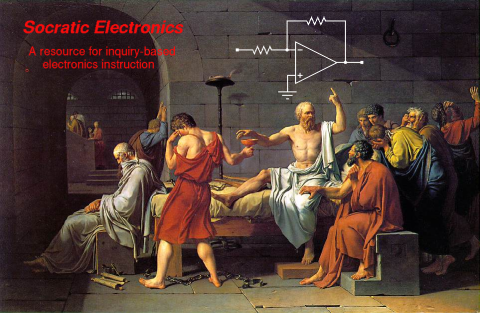
What is Socratic Electronics?*
We live in a world where the accumulation of knowledge is exponential over time, and where the ability to continuously learn and make sound judgments is essential to survival. Formal education ought to play an important role in preparing individuals to succeed in this environment, but many traditional modes of education actually discourage development of independent thinking skills necessary for success.
The most important thing any educator can impart to a student, in any context, is the ability to teach themselves. When teachers dispense knowledge to students in the traditional lecture format -- where students passively watch and listen -- they deny students deep interaction with the subject matter. Furthermore, instructor-centered pedagogy assumes and reinforces the debilitating notion that education can only happen in the presence of a superior: You (the student) need me (the teacher) in order to learn.
Placing students at the center of the instructional process breaks this dependency. A time-tested way of centering instruction around students is to teach by asking questions. This is generally called the ``Socratic method,'' made famous by the Greek philosopher Socrates. Another way to center instruction around students is to have them share their new-found knowledge with others. As any teacher knows, ``when you teach, you learn twice.'' I have found that a synthesis of these two instructional techniques -- stimulating student thought by asking lots of questions, and consolidating new-found knowledge through presentation -- not only fosters learning at a deeper level than I have ever experienced in a lecture-based course, but also builds confidence and self-teaching ability within students.
The purpose of this website is to provide both rationale and resources for research/discussion-based instruction to instructors everywhere. Central to the Socratic Electronics project is a large collection of questions and answers, intended as student assignments. By requiring students to research answers to these questions, then present their findings in class, students learn how to locate information, problem-solve, collaborate, and clearly articulate their thoughts while learning the basic subject matter. While the resources provided on this site are specifically designed for teaching electronics, the method itself is applicable to a wide variety of disciplines. I welcome constructive criticism, as well as participation in the development of this learning resource.
An important feature of these questions and answers is that they are configurable. They are organized in such a format as to be assembled into custom worksheets suitable for use in a variety of electronics classroom settings. Thus, you are not bound to using the compiled worksheets as they appear on this website. Rather, you may easily select which problems you wish to have on your own worksheet(s), and create them automatically by editing and executing a simple computer ``script'' file.
For those interested in the genesis and application of this teaching philosophy, here is a "manifesto'' I've written on the subject of learning to learn. It briefly chronicles my experiences with this learning method during the first year of its application in my class.
* Excerpted directly from the Socratic Electronics Website.
Subscribe to:
Posts (Atom)