Google for Educators.
You must check it out. Now!
Saturday, November 10, 2007


Saturday, October 13, 2007
Donor's Choose

If you haven't heard of this site already, you must visit it. Now!
This site allows teachers to write 'mini-grants' to fund small classroom projects and allows regular folks like you and me to quickly and easily donate to those projects, knowing our funds are going directly to help improve classroom instruction. How cool is that?

Right now, there is a $100,000 blogger challenge being run by Sarah Bunting of Tomato Nation. So far, over $75,000 has been donated to teachers and their students across the United States.
Seriously, cool it get any more awesome??
Friday, October 12, 2007
Socratic Electronics
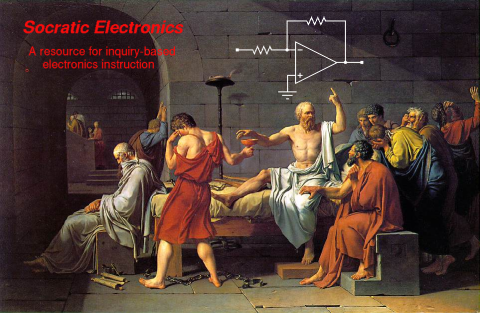
What is Socratic Electronics?*
We live in a world where the accumulation of knowledge is exponential over time, and where the ability to continuously learn and make sound judgments is essential to survival. Formal education ought to play an important role in preparing individuals to succeed in this environment, but many traditional modes of education actually discourage development of independent thinking skills necessary for success.
The most important thing any educator can impart to a student, in any context, is the ability to teach themselves. When teachers dispense knowledge to students in the traditional lecture format -- where students passively watch and listen -- they deny students deep interaction with the subject matter. Furthermore, instructor-centered pedagogy assumes and reinforces the debilitating notion that education can only happen in the presence of a superior: You (the student) need me (the teacher) in order to learn.
Placing students at the center of the instructional process breaks this dependency. A time-tested way of centering instruction around students is to teach by asking questions. This is generally called the ``Socratic method,'' made famous by the Greek philosopher Socrates. Another way to center instruction around students is to have them share their new-found knowledge with others. As any teacher knows, ``when you teach, you learn twice.'' I have found that a synthesis of these two instructional techniques -- stimulating student thought by asking lots of questions, and consolidating new-found knowledge through presentation -- not only fosters learning at a deeper level than I have ever experienced in a lecture-based course, but also builds confidence and self-teaching ability within students.
The purpose of this website is to provide both rationale and resources for research/discussion-based instruction to instructors everywhere. Central to the Socratic Electronics project is a large collection of questions and answers, intended as student assignments. By requiring students to research answers to these questions, then present their findings in class, students learn how to locate information, problem-solve, collaborate, and clearly articulate their thoughts while learning the basic subject matter. While the resources provided on this site are specifically designed for teaching electronics, the method itself is applicable to a wide variety of disciplines. I welcome constructive criticism, as well as participation in the development of this learning resource.
An important feature of these questions and answers is that they are configurable. They are organized in such a format as to be assembled into custom worksheets suitable for use in a variety of electronics classroom settings. Thus, you are not bound to using the compiled worksheets as they appear on this website. Rather, you may easily select which problems you wish to have on your own worksheet(s), and create them automatically by editing and executing a simple computer ``script'' file.
For those interested in the genesis and application of this teaching philosophy, here is a "manifesto'' I've written on the subject of learning to learn. It briefly chronicles my experiences with this learning method during the first year of its application in my class.
* Excerpted directly from the Socratic Electronics Website.
Wednesday, October 10, 2007
Tuesday, October 9, 2007


Monday, October 8, 2007
More Links!

Hat Tip to LifeHacker for the links.
- Go to Med School Online For Free. University of Michigan Medical School
- Virtual Microscope!
- Better than Dr. Google: University of Connecticut's online pathology museum.
- Plant life database: The Louisiana State University Herbarium.
- Night Sky Report: Harvard's Center for Astrophysics.
- Hi Res Images: University of Arizona HiRise
- The Speech Accent Archive: at George Mason University
- World Images Portfolio: at San Jose State University
- Scholarly Journal Articles online: Johns Hopkins University Project Muse.


Tuesday, August 28, 2007
Kid Friendly Activities,
Courtesy of Uncle Sam (hat tip to Meta Filter for the links). (The entire article here.)
Bored on your summer vacation? Well, the US government has lots of fun stuff for kids to do on line. Learn fascinating facts about cows (and agricultural marketing!) from the Department of Agriculture. Take a ride to Money Central Station with the Bureau of Engraving and Printing. If you live in a federally-funded housing project, HUD wants you to learn more about being a good citizen. Want something more action-packed? Help FBI Special Agent Bobby Bureau go undercover, or become one of America's Crypto-Kids at the NSA. Play thrilling puzzle games or visit the world's most secret museum at the CIA. Play more games or become a Disaster Action Kid at FEMA! And no list of government kids' pages would be complete without revisiting the children's art contest from the ATF
Howtoons

From the pages of Make Magazine is a cool new website--Howtoons.
These great illustrations offer one-page directions for neat science-related projects.
Cool New Tool---Coming Soon!
Yahoo is coming out with Yahoo! Teacher, a peer network to create, modify and share curriculum & lesson plans. What a cool idea!

Students Behave When Engaged
A great article by Anthony Cody, an award winning middle school science teacher says,
"The secret to behavior management is really about having the students fully engaged in the learning process, and it involves more than just rules and office referrals. After all, the whole point of getting the class to focus is to do some meaningful work—to reach new understandings, to create new expressions of their knowledge, and to build new skills. But we have to know how to manage our teacher-student relationships in order to get there."Good Stuff!
Sunday, August 19, 2007
Barbara Morgan in Space
Thursday, August 9, 2007
Educator in Space!

21 years after the Challenger disaster, there is a teacher in space!
Barbara Morgan was the back-up teacher/astronaut for Christa McAuliffe, the teacher who died on January 28, 1986 when the Challenger Shuttle exploded 73 seconds into its flight.
Teachers can follow Morgan's experience online at NASA's website.
Teachers can find more science/space lessons at the Saturday Morning Science website, where astronauts at the International Space Station perform labs for kids.
UPDATED: I just learned that teacher Barbara Morgan will be updating us on her journey via the Sally Ride blog. Woo-hoo!
Wednesday, August 8, 2007
Speaking of Harry Potter...
What? You weren't speaking of Harry Potter just now? Well, Miss Sass was! She loves HP and all the great wizardry involved in the non-muggle world. But did you know us muggles are getting close to building an invisibility cloak of our own? Oh, yes! It's true.

You know what else is cool? All of the myth references that show up in the wizard world. Dave's Mythical Creatures website has a pretty extensive list of (you guessed it) mythical creatures, including several creatures from Potter-land, like dragons, a phoenix, unicorns, mermaids, and even Fluffy.

You know what else is cool? All of the myth references that show up in the wizard world. Dave's Mythical Creatures website has a pretty extensive list of (you guessed it) mythical creatures, including several creatures from Potter-land, like dragons, a phoenix, unicorns, mermaids, and even Fluffy.
Color like no other...

Miss Sass is certain you can use this video to illustrate something in your science classes--kinetic energy, maybe? Regardless, it's just a cool, cool video and Miss Sass wishes she were there when they were making it!
If you want more information about the video, you can get it by going to Sony's Bravia website.
Math = Art

Want to teach solids in your classroom? Try these paper polyhedra activities. Requires construction paper and a little patience, but how cool are these?
Smart Games
If you are anything like Miss Sass, you like to play games. If you are even more like Miss Sass, you like games that require you to use your intelligence and ingenuity to get to the next level, not just great hand-eye coordination. Miss Sass presents her list of really cool nerdy games:
- Armadillo Run. Armadillo Run is a physics-based puzzle game. You have to build structures with the purpose of getting an armadillo to a certain point in space. There is a selection of building materials, each with different properties, which can be combined to form almost anything. The realistic physics simulation gives you the freedom to solve each level in many different ways.
- Cryptic Sea. A whole slew of cool games that all have science backgrounds.
- Telescope Game. Written by Dyson Vacuums, this game gets harder as you go...
- Chromatron. One of the coolest, and most addictive laser logic games ever. Miss Sass loves this game!
- Gravity Pods: Like chromatron, but different rules. Way cool.
- OrBox B: Like chromatron or gravity pods, but again, a different set up. Still way cool.
Do you know TED?
TED stands for Technology, Entertainment, Design and was created in 1984 as a conference to bring people together from those three arenas. Now, TED Talks are a series of amazing video speeches from the TED conferences expounded on any number of funny and fascinating topics. Showing TED Talks in class are a great way to get students thinking and start a meaningful discussion on the different topics. Miss Sass will highlight some of her favorite TED Talks below.
Emily Oster: What we know about AIDS. Emily Oster, a University of Chicago economist, looks at the stats on AIDS in Africa -- and comes up with a stunning conclusion: Everything we know about AIDS in sub-Saharan Africa is wrong. We look for root causes such as poverty and poor health care -- but we also need to factor in, say, the price of coffee, and the routes of long-haul truckers. In short, there is a lot we don't know; and our assumptions about what we do know may keep us from finding the best way to stop the disease.
David Bolinsky: Fantastic Voyage inside a cell. Medical animator David Bolinsky presents 3 minutes of stunning animation that show the bustling life inside a cell (you HAVE to watch this video too--it's so cool!) Built by his company, XVIVO, to teach Harvard medical students, the clip features sweeping cinematic values and even a little drama. It communicates not only the facts of life, but life's truth and beauty.
Burt Rutan: Entrepreneurs are the Future of Space Flight. In this passionate talk, legendary spacecraft designer Burt Rutan lambastes the US government-funded space program for stagnating: "Houston, we have a problem. We're entering a second generation of no progress." He calls for entrepreneurs to lead the next wave of space exploration, funding new crafts, new (manned) missions, and entirely new approaches to space exploration.
There are tons of great videos--Miss Sass implores you to check them all out!
Emily Oster: What we know about AIDS. Emily Oster, a University of Chicago economist, looks at the stats on AIDS in Africa -- and comes up with a stunning conclusion: Everything we know about AIDS in sub-Saharan Africa is wrong. We look for root causes such as poverty and poor health care -- but we also need to factor in, say, the price of coffee, and the routes of long-haul truckers. In short, there is a lot we don't know; and our assumptions about what we do know may keep us from finding the best way to stop the disease.
David Bolinsky: Fantastic Voyage inside a cell. Medical animator David Bolinsky presents 3 minutes of stunning animation that show the bustling life inside a cell (you HAVE to watch this video too--it's so cool!) Built by his company, XVIVO, to teach Harvard medical students, the clip features sweeping cinematic values and even a little drama. It communicates not only the facts of life, but life's truth and beauty.
Burt Rutan: Entrepreneurs are the Future of Space Flight. In this passionate talk, legendary spacecraft designer Burt Rutan lambastes the US government-funded space program for stagnating: "Houston, we have a problem. We're entering a second generation of no progress." He calls for entrepreneurs to lead the next wave of space exploration, funding new crafts, new (manned) missions, and entirely new approaches to space exploration.
There are tons of great videos--Miss Sass implores you to check them all out!
It ain't easy being green!
When Miss Sass was a little Sassette, she convinced her whole family that they had to recycle. Now that Miss Sass lives on her own, she's found that recycling takes a lot of extra effort and has been too lazy to separate her plastics from her papers and put them all in the recycling containers in her apartment buildings (ugly, scary) basement.
Miss Sass felt pretty guilty about not recycling though, until she read this article! According to John Tierney, recycling isn't as helpful to the environment as we may once have thought.
And, recycling is expensive!
One cool solution I came across is the vertical farm. With the world's population growing, urban areas are growing and reducing the amount of rural and arable land-space available for growing food. By creating vertical farming, one can grow food enough food for thousands of people in the space of one skyscraper!
And that's all Miss Sass has to say about the environment, for now anyway.
Miss Sass felt pretty guilty about not recycling though, until she read this article! According to John Tierney, recycling isn't as helpful to the environment as we may once have thought.
Plastic packaging is routinely criticized because it doesn't decay in landfills, but neither does most other packaging, as William Rathje, an archaeologist at the University of Arizona, has discovered from his excavations of landfills. Rathje found that paper, cardboard and other organic materials-while technically biodegradable-tend to remain intact in the airless confines of a landfill. These mummified materials actually use much more landfill space than plastic packaging, which has steadily been getting smaller as manufacturers develop stronger, thinner materials. Juice cartons take up half the landfill space occupied by the glass bottles they replaced; 12 plastic grocery bags fit in the space occupied by one paper bag.
Collecting a ton of recyclable items is three times more expensive than collecting a ton of garbage because the crews pick up less material at each stop. For every ton of glass, plastic and metal that the truck delivers to a private recycler, the city currently spends $200 more than it would spend to bury the material in a landfill. City officials hoped to recover this extra cost by selling the material but the market price of a ton has never been anywhere near $200. In fact, it has rarely risen as high as zero. Private recyclers usually demand a fee because their processing costs exceed the eventual sales price of the recycled materials. So the city, having already lost $200 collecting the ton of material typically has to pay another $40 to get rid of it.The recycling program has been costing $50 million to $100 million annually, and that's just the money coming directly out of the municipal budget. There's also the labor involved. the garbage-sorting that millions of New Yorkers do at home every week. How much would the city have to spend if it couldn't rely on forced labor? True, some people would probably be glad to do the work for free because they regard garbage sorting as a morally uplifting activity for the whole family. But many others have refused to follow the law. They seem to have a more traditional view of garbage sorting: an activity done only for money, and then only by the most destitute members society.
I tried to estimate the value of New Yorkers' garbage sorting by financing an experiment by a neutral observer (a Columbia University student with no strong feelings about recycling). He kept a record of the work he did during one week complying with New York's recycling laws. It took him eight minutes during the week to sort, rinse and deliver four pounds of cans and bottles to the basement of his building. If the city paid for that work a typical janitorial wage ($12 per hour), it would pay $792 in home labor costs for each ton of cans and bottles collected And what about the extra space occupied by that recycling receptacle in the kitchen? It must take up at least a square foot, which in New York costs at least $4 a week to rent. If the city had to pay for this space, the cost per ton of recyclable would be about $2,000. That figure plus the home labor costs, added to what the city already spends on its collection program, totals more than $3,000 for a ton of scrap metal, glass and plastic. For that price, you could find a one-ton collection of those materials at a used-car lot-a Toyota Tercel for instance-and drive home in it.
Lest you Miss Sass readers think that Miss Sass is a complete anti-green anarchist, let me say that I have no problem with the United States and the world finding better solutions for utilizing our natural resources. I just think that we should be sure that our solutions are actually better than the problem.
One cool solution I came across is the vertical farm. With the world's population growing, urban areas are growing and reducing the amount of rural and arable land-space available for growing food. By creating vertical farming, one can grow food enough food for thousands of people in the space of one skyscraper!
And that's all Miss Sass has to say about the environment, for now anyway.
Classroom Crime Scenes....
Now, there is nothing Miss Sass likes better than a good crime scene...for the science of it, of course. (I know you didn't think Ms. Sass was a criminal, did you?) Anywho, I've been teaching crime scene investigation to middle school students this year, and have amassed quite a few cool web links for forensic science information. Don't tell anyone that I've done your homework for you--that's a *real* crime!
Forensic Science Links
Forensic Science Links
- Forensic Science Cases. If you are looking for cases that help illustrate the use of forensic science techniques, look no further than Court TV's Crime Library. I used the Charles Lindburgh kidnapping case to help illustrate the use of handwriting analysis. (For another lengthy case involving handwriting analysis, read "Tracking the White Salamander" online.) The Why Files also uses the Natalie Holloway case to discuss forensic investigation techniques.
- Crime Scenes. Create your own classroom crime scene, like the case of the Barefoot Burglar.
- General Forensic Science Links.
- Discovery School's Forensic Science Lessons (grades 6-12)
- How Stuff Works: How Crime Scene Investigation Works.
- National Institute of Health (NIH): Visible Proofs Website--All kinds of cool information, lessons, cases, videos, pictures, etc. on forensic science.
- ThinkQuest: Forensic Science website, includes information on hair & fibers, fingerprinting and blood.
- Home Science Tools: Buy the book on Crime Scene Investigations for your classroom.
- Handwriting Analysis. This is a low-budget science--you just need paper and pens! In addition to the links listed above, you can find more information on handwriting analysis at Discovery School.
- Fingerprinting. Fingerprinting is a great subject for forensic science and the kids love it. There are tons of great websites on fingerprinting; I've linked to just a few that I've used.
- Forensic Science Activities: This site has information on fingerprinting, shoe prints, lip prints, handwriting analysis, and chromatography.
- Cryptography. Nothing says spy like secret codes. Although not strictly a "forensic science," it's also something that gets kids excited about math (formal logic) and technology (code cracking).
- Invisible Ink: You can't crack the code if you can't see the writing!
- Unsolved Codes: Try cracking real codes that haven't ever been solved.
- DNA Analysis. This one is harder to do in the classroom, but there are plenty of cool videos and other online resources. One fun lab project allows you to separate your own DNA! (Note: Methylated Spirits, as called for in this lab, is the fancy British way of saying "rubbing alcohol.") NIH also has a lab project for high school students. Want to know how the government deals with DNA analysis? Go to DNA.gov and find out.
- Hair & Fiber Analysis. Nobody says it better than the FBI. A little less scientific explanation from Thinkquest.
- Bloodstain Pattern Analysis. Sometimes this website loads wonky, but it's worth it for all the great information and pictures on how BPA works.
Welcome!
 Hi! Miss Sass, the Science Lass, here and at your service! I'll be posting my favorite science, technology, mathematics, and education-related links. Feel free to comment, add your advice, or make requests. Have a sciencey day!
Subscribe to:
Posts (Atom)